
This page contains a description of Turkey’s autocratization episode, as well as an analysis of its environmental performance during the autocratization episode using literature and EPI data.
democratic performance
It has been argued that Turkey became a competitive authoritarian regime under president Recep Tayyip Erdoğan. Elections still take place, and they are not manipulated systematically. However, the playing field is highly uneven, skewed in favor of Erdoğan’s AKP party (Esen & Gumuscu, 2016, p. 3, 6). In 2010, the composition of the Supreme Election Council was changed in such a way that the government’s influence was increased. Additionally, parties were not allowed to campaign for extended periods, which benefited the ruling AKP, which campaigned unofficially at public events (Esen & Gumuscu, 2016, p. 6). There have also been attacks on opposition activists. Lastly, public resources have been used to benefit the AKP (Esen & Gumuscu, 2016, p. 7, 9). In terms of civil liberties, Turkey became more autocratic too. There has been political, financial and legal pressure on the media (Esen & Gumuscu, 2016, p. 11). Since 2013, 170 journalists have been killed, detained or reported missing. Recently, a major new autocratic action was taken with the arrest of Istanbul’s mayor and leading opposition figure Ekrem İmamoğlu (D’Angelo, 2025).
environmental performance according to literature
Turkey has launched initiatives to improve its environmental outcomes. In 2021, president Erdoğan announced Turkey’s goal to reach net-zero emissions by 2053. There has also been a “Zero Waste Initiative”, focused on a circular economy, plastic reduction and recycling (ISESG, 2025). In 2025, an emission trading system based on the EU’s model was created, and Turkey’s net zero targets were enshrined into law (Climate Action Tracker, 2025; Gide, 2025). However, the government has made an effort to increase fossil gas production and for Turkey to become a fossil gas hub (Climate Action Tracker, 2025). Additionally, there are subsidies on coal (ISESG, 2025). According to the Climate Action Tracker (2025), Turkey’s climate targets, policies and finance are “critically insufficient”.
environmental performance according to epi
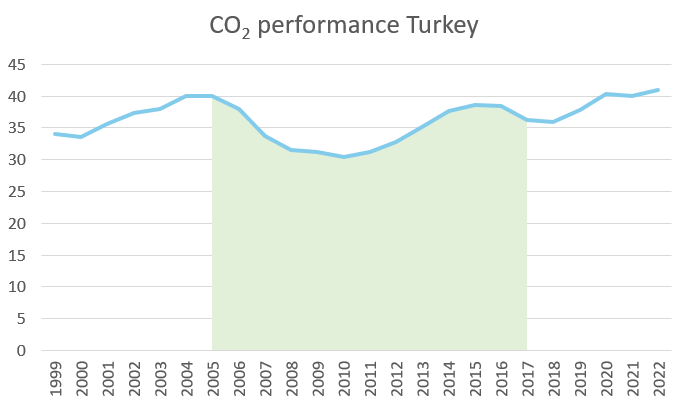
The area marked green is the autocratization episode.
Turkey’s most recent CO2 performance is around the same level as it was in 2004. Its performance dropped during the beginning of the autocratization episode and started increasing again around halfway through the episode. The performance was slightly lower at the end of the autocratization episode compared to the start.
conclusion
Turkey became an electoral autocratic regime under president Erdoğan. The electoral playing field became less fair and civil liberties have been attacked. The recent arrest of a leading opposition figure showed that Turkey is continuing this autocratic trajectory. In terms of environmental performance, targets have been put in place, but Turkey has been continuing its fossil fuel production. Turkey’s climate targets, policies and finance have been described as “critically insufficient” by the Climate Action Tracker.
literature
Climate Action Tracker. (2025). Türkiye: Country summary. https://climateactiontracker.org/countries/turkey/
D’Angelo, M. (2025, October 29). How Turkey is cracking down on the media. The Conversation. https://theconversation.com/how-turkey-is-cracking-down-on-the-media-267589
Esen, B., & Gumuscu, S. (2016). Rising competitive authoritarianism in Turkey. Third World Quarterly, 37(9), 1581–1606. https://doi.org/10.1080/01436597.2015.1135732
Gide. (2025, July 11). The Turkish Climate Law No 7552. https://www.gide.com/news-insights/the-turkish-climate-law-no-7552/
ISESG. (2025, July 7). Between Earthquakes and Energy: Turkey’s ESG Reckoning in a Fragile Geopolitical Landscape. https://www.isesg.org/post/between-earthquakes-and-energy-turkey-s-esg-reckoning-in-a-fragile-geopolitical-landscape