
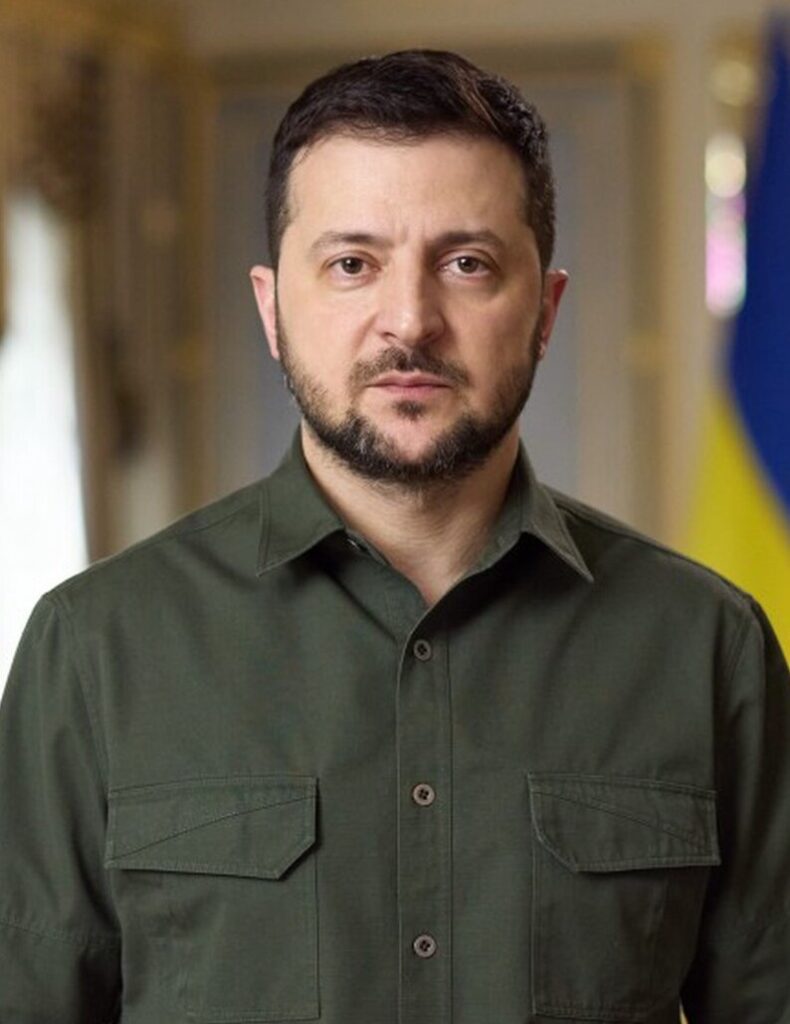
This page contains a description of Ukraine’s autocratization episode, as well as an analysis of its environmental performance during the autocratization episode using literature and EPI data.
democratic performance
After Russia invaded Ukraine, Ukraine introduced martial law, prohibiting men ages 18 to 60 from leaving the country (Gilbert, n.d.). This is a restriction on individuals’ freedom, but it could be considered an appropriate one given the war against Russia. That is the stance of the European Commission (2023), which has stated that the martial law has led to the “derogation of certain fundamental rights”, but also that the measures are overall “proportionate to the situation in the country”.
In July 2025, president Zelensky signed a law bringing over two anti-corruption bodies under the control of the prosecutor general, a position filled by the president. After protests, Zelensky signed a bill restoring those institutions’ independence, but prosecutors may still be removed by the prosecutor general’s office. This has been described as a potential curbing of prosecutors’ independence and a challenge to anti-corruption reforms (Ukrainian Research Institute at Harvard University, n.d.).
environmental performance according to literature
The war against Russia has, on the one hand, led to lower greenhouse gas emissions due to reduced industrial production and the destruction of energy facilities. On the other hand, military operations have led to new emissions. According to an estimate by the Planetary Security Initiative (2025), total war-related emissions are comparable to the combined annual emissions of Austria, Hungary, the Czech Republic and Slovakia. Additionally, there has been a deterioration of pollution impacting air quality and soil and an increased risk of forest fires (European Commission: Joint Research Centre, 2025). Monitoring of the forests has ceased in certain areas (Belis et al., 2025, p. 6). The war has also had negative effects for Ukraine’s water security. Russian troops have repeatedly used water as a weapon by destroying critical water infrastructure (Snizhko et al., 2024).
Because of the damage to water, land and forests and the additional greenhouse gas emissions due to the war, Ukraine has sought nearly $44 billion in damages from Russia (Shah, 2025).
It has been argued within the context of the Russo-Ukrainian war that conflict and climate change exacerbate each other, creating a vicious cycle (Gilliver, 2026).
environmental performance according to epi
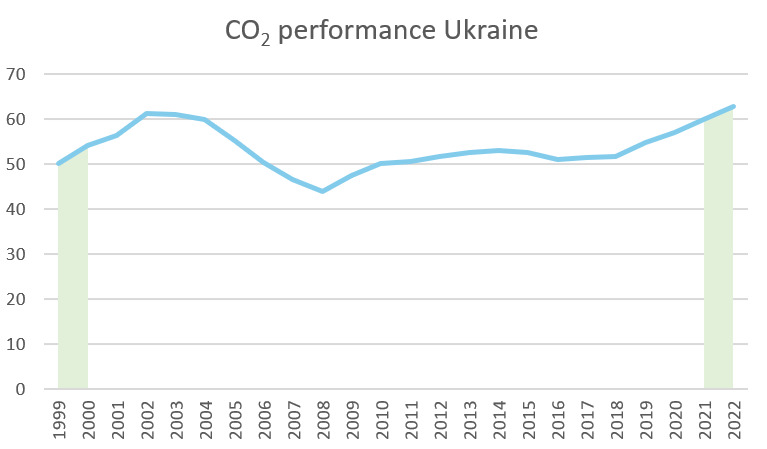
The areas marked green are the autocratization episodes.
Ukraine slightly improved its CO2 performance during both autocratization episodes. Note that there is little data to use regarding Ukraine’s CO2 performance according to the EPI. There is EPI data for only a small part of the first autocratization episode, and EPI data for the second autocratization episode is limited too.
conclusion
Ukraine restricted civil liberties after the war by introducing martial law. However, this is arguably justified given the situation. Ukraine did autocratize recently by bringing over two anti-corruption bodies under the control of the prosecutor general. Following protests, those institutions’ independence was restored, but prosecutors may still be removed by the prosecutor general’s office, which has been criticized by scholars. In terms of environmental performance, Ukraine’s environment has been significantly negatively impacted by the war, such as in the form of poorer air quality and reduced water security. Additionally, greenhouse gas emissions have increased significantly.
literature
Belis, C. A., Petrosian, A., Turos, O., Maremuhka, T., Morhulova, V., Kona, A., Djatkov, D., Caudullo, G., Ceccherini, G., Beck, P. S. A., San‑Miguel, J., Arias Navarro, C., Wojda, P., Jones, A., Hanke, G., Mariani, G., & Carravieri, A. (2025). Status of environment and climate in Ukraine: Assessing the impact of war and its implications for reconstruction. Publications Office of the European Union. https://op.europa.eu/publication-detail/-/publication/bca7b880-1033-11f0-b1a3-01aa75ed71a1
European Commission. (2023, November). 2023 Communication on EU Enlargement Policy. https://enlargement.ec.europa.eu/system/files/2023-11/COM_2023_690%20Communication%20on%20EU%20Enlargement%20Policy_and_Annex.pdf
European Commission: Joint Research Centre. (2025, April 11). War worsens climate and environmental challenges in Ukraine. https://joint-research-centre.ec.europa.eu/jrc-news-and-updates/war-worsens-climate-and-environmental-challenges-ukraine-2025-04-11_en
Gilbert, A. C. (n.d.). Report: Ukraine bans all male citizens ages 18 to 60 from leaving the country. USA Today. https://eu.usatoday.com/story/news/world/2022/02/25/russia-invasion-ukraine-bans-male-citizens-leaving/6936471001/
Gilliver, L. (2026, February 24). From fossil fuelled tanks to wildfires: How Russia’s war on Ukraine is destroying the planet. Euronews. https://www.euronews.com/2026/02/24/from-fossil-fuelled-tanks-to-wildfires-how-russias-war-on-ukraine-is-destroying-the-planet
Planetary Security Initiative. (2025, February 24). Climate damage caused by the Russian War in Ukraine in three years: The key numbers. https://www.planetarysecurityinitiative.org/news/climate-damage-caused-russian-war-ukraine-three-years-key-numbers
Shah, S. (2025, January 16). Ukraine to Claim $44bn in Climate Damages From Russia. Why War Is So Bad For Emissions. https://time.com/7335449/ukraine-russia-war-climate-impact/
Snizhko, S., Didovets, I., & Bronstert, A. (2024). Ukraine’s water security under pressure: Climate change and wartime. Water Security, 23. https://doi.org/10.1016/j.wasec.2024.100182
Ukrainian Research Institute at Harvard University (n.d.). Zelensky’s Anti-Corruption Missteps: Experts Respond. https://www.huri.harvard.edu/zelenskys-anti-corruption-missteps-experts-respond