
This page contains a description of Tunisia’s autocratization episode, as well as an analysis of its environmental performance during the autocratization episode using literature and EPI data.
democratic performance
Tunisia’s citizens overthrew their dictator in 2011, leading Tunisia to become a democracy (Democratic Erosion Consortium, 2025). However, the country has autocratized significantly, especially in recent years. In July 2021, Tunisian president Kais Saied sacked the prime minister, froze the work of the parliament, and lifted the immunity of all parliamentarians. Since then, president Saied has been ruling by decree (Radeck, 2022, p. 22). He has also forbidden external funding of the work of NGOs within Tunisia (Radeck, 2022, p. 24). In 2022, he passed a new constitution which massively expanded the president’s powers. The legislative branch was rendered powerless, the president gained absolute control of the executive branch and there were no more checks on the president’s powers (Democratic Erosion Consortium, 2025).
environmental performance according to literature
Tunisia has grappled with environmental challenges, including air and water pollution, land degradation, desertification, waste mismanagement and biodiversity loss. According to observers, the environmental performance has fallen short of expectations, despite considerable public spending. Environmental experts have pointed to the failure to invest in waste recycling and recovery, the absence of initiatives to extract reusable materials for energy production and a lack of incentives for the industry to curb waste and phase out environmentally harmful products (The Arab Weekly, n.d.). Experts have also noted the persistent high levels of sulfur dioxide and ammonia in the atmosphere (Associated Press, 2025).
President Saied has stated that the right to a healthy environment is a fundamental human right (The Arab Weekly, n.d.). He has also called for urgent measures to “halt the blatant and persistent environmental degradation and protect the coastline” (News Tunisia, 2025).
environmental performance according to epi
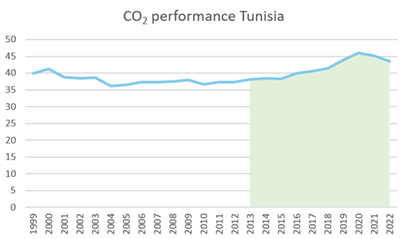
The area marked green is the autocratization episode.
Tunisia’s CO2 performance has been fairly stable over time. It increased slightly during the autocratization episode. Its current CO2 performance is slightly higher than it was in 1999.
conclusion
Tunisia autocratized significantly under president Saied. The president removed major checks on executive power. Regarding the environment, Tunisia continues to struggle with environmental problems. President Saied has argued in favor of environmental action to address them. Tunisia’s CO2 performance has been fairly stable over time, but it improved slightly during the autocratization episode.
literature
Associated Press. (2025, October 16). Violence erupts during anti-pollution protest as anger boils in Tunisia’s phosphate belt. AP News. https://apnews.com/article/tunisia-gabes-phosphate-protests-violence-injuries-ca222626d89ffb1ec5e17bb71dd677b1
Democratic Erosion Consortium. (2025, December 12). Tunisia’s authoritarian turn: How President Kais Saied is dismantling the Arab Spring’s only democracy. https://democratic-erosion.org/2025/12/12/tunisias-authoritarian-turn-how-president-kais-saied-is-dismantling-the-arab-springs-only-democracy/
News Tunisia. (2025, July 10). Tunisia – Saied calls for urgent measures to halt environmental degradation and protect the coastline. https://news-tunisia.tunisienumerique.com/tunisia-saied-calls-for-urgent-measures-to-halt-environmental-degradation-and-protect-the-coastline/
Radeck, M. (2022). Tunisia’s Deadlocked Situation: President Saied Takes the Authoritarian Exit. Horizon Insights, 5(1), 25-34. https://doi.org/10.31175/hi.2022.01.03
The Arab Weekly. (n.d.). Tunisian president blasts years of mismanagement in environmental crisis. https://thearabweekly.com/tunisian-president-blasts-years-mismanagement-environmental-crisis